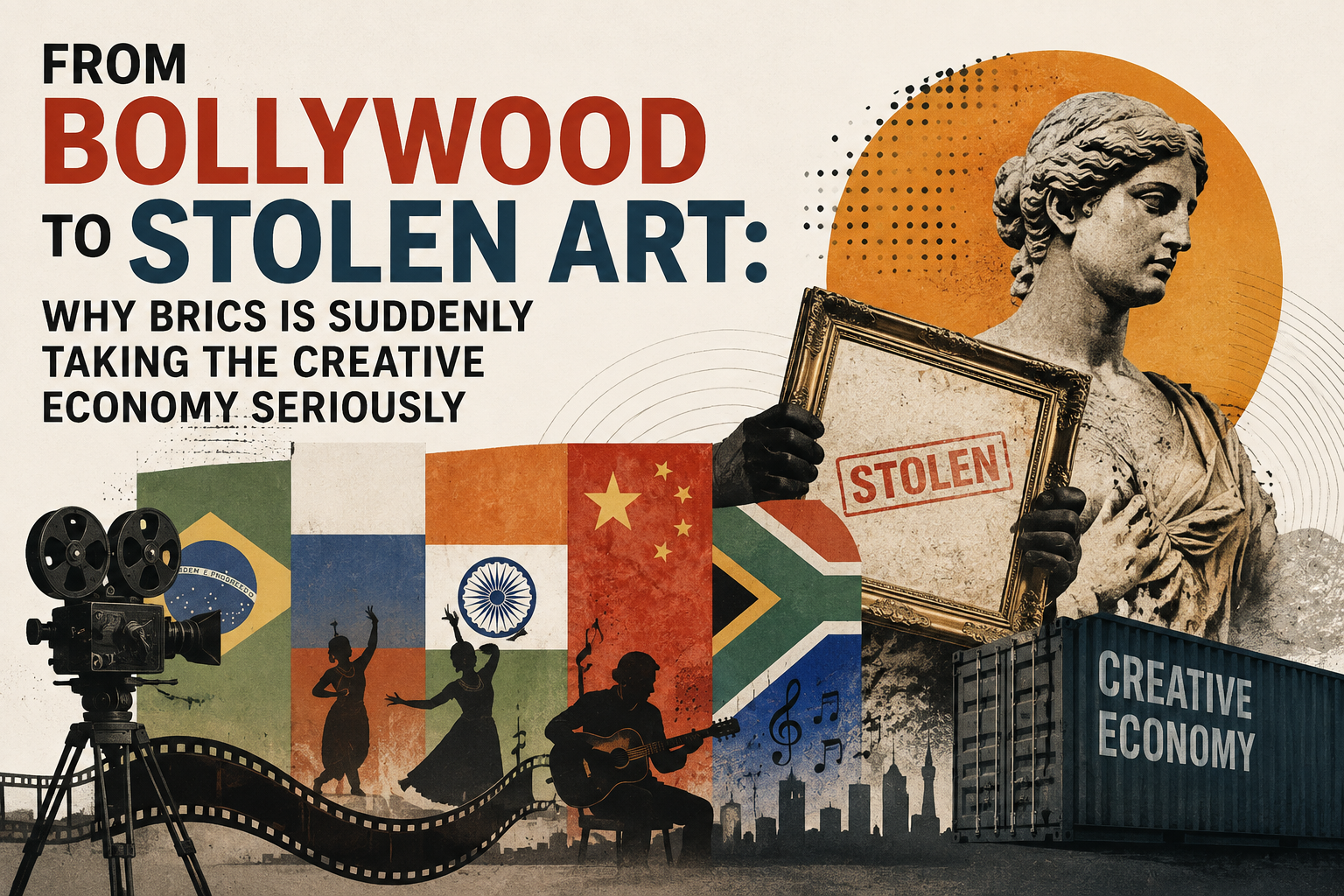
For years, BRICS has been associated with rather unromantic things: oil, steel, grain, infrastructure and the long-running quest to make emerging economies less dependent on Western financial institutions. Culture was mostly a backdrop to the serious business. But the creative economy is acquiring an unexpectedly prominent place in the BRICS machinery.
In Bhopal this week, ministers from the enlarged grouping adopted a declaration that explicitly advances cooperation in the cultural and creative industries and the creative economy. The agenda includes supporting creators, sharing best practice, building professional networks and using digital tools to give artists and craftspeople access to new markets. India also announced a pilot Voluntary Artist Registry intended to facilitate exchanges and create opportunities for creative practitioners across BRICS.
This is not quite the arrival of a BRICS version of Hollywood. But it may signal something more consequential: a recognition that economic power in the 21st century is not produced only in factories, mines and ports. It is also produced in studios, design houses, game-development companies, film sets, music catalogues and digital platforms.
The timing is revealing. India, the BRICS chair in 2026, has made the so-called “orange economy” part of its domestic economic policy. In February its finance minister announced support for animation, visual effects, gaming and comics, including plans for content-creator laboratories in 15,000 secondary schools and 500 colleges. The government estimates that the sector could require two million professionals by 2030.
India is hardly alone. China has spent years trying to move from “Made in China” towards “Created in China”, building industries around film, gaming, design and digital content. Brazil has a long-standing creative-economy policy tradition and one of the world’s largest cultural markets. South Africa has its own established creative industries, from music and film to fashion and design. Egypt brings the considerable cultural weight of one of the world’s oldest civilisations, alongside a large Arabic-language film, television and music industry.
For BRICS, the attraction is obvious. Creative goods are unusually well suited to a world in which digital distribution can be cheaper than shipping a container. A song, game, film, fashion design or digital artwork can cross borders without crossing a customs checkpoint.
More importantly, creativity offers emerging economies a route into higher-value economic activity. A country does not necessarily need to possess vast reserves of oil or a globally dominant manufacturing sector to export intellectual property. Its competitive advantage can be a language, a story, a style, a visual tradition or a pool of talented young people.
That makes the creative economy particularly interesting for the Global South.
The economic case is already substantial. The OECD describes cultural and creative sectors as drivers of wealth, employment and innovation, while a BRICS-focused analysis published in 2025 argued that creative industries could become a significant area of cooperation as the global creative economy expands.
Yet there is a danger in treating the creative economy as a fashionable new label for old cultural policy. A festival is not an industry. A cultural exchange is not an export strategy. And an artist registry, useful though it may be, does not by itself create international markets.
The more interesting development in Bhopal is therefore not the rhetoric but the attempt to build mechanisms around it.
The Bhopal Declaration calls for cooperation that includes market access and digital tools. That matters. One of the chronic problems facing creative workers in developing economies is not a shortage of talent but a shortage of routes from talent to paying markets. Digital platforms can reduce that barrier, although they introduce another problem: the platforms themselves are often controlled by large companies outside the countries whose creators supply the content.
BRICS therefore faces a familiar paradox. It wants greater economic sovereignty while relying on a digital ecosystem in which much of the infrastructure, distribution and intellectual-property power sits elsewhere.
The same tension appears in the declaration’s treatment of cultural heritage.
The Bhopal meeting put the recovery of stolen and illegally transported cultural heritage on the agenda. That is partly a question of historical justice, but it is also an economic one. Museums, heritage sites, creative tourism, publishing, film and design all depend on the ability of countries to preserve, document and commercially develop their cultural assets. BRICS ministers have consequently begun treating heritage not simply as something to be protected behind glass, but as an asset that can support wider cultural and economic ecosystems.
Egypt’s intervention this week illustrates the point from another direction. It called for stronger BRICS cooperation to protect cultural heritage, combat illicit trafficking of cultural property and use culture to support innovation, sustainable development and social cohesion.
There is also a geopolitical dividend.
Creative industries produce something economists struggle to put neatly into a spreadsheet: soft power. South Korea’s experience is instructive. Its government has increasingly treated music, television, games, beauty and food as strategic exports rather than merely successful consumer products. Reuters reported last year that Seoul was seeking to make cultural exports a new engine of growth as traditional manufacturing faced a more difficult global environment.
BRICS countries have comparable ambitions, though they are starting from very different positions. Bollywood, Brazilian music, Chinese games, Egyptian cinema, Russian literature and South African music already possess audiences beyond their home markets. A more coordinated BRICS cultural strategy could turn those scattered strengths into networks for distribution, investment, tourism and intellectual-property exchange.
The question is whether the politics can keep up.
BRICS is now a much larger and more heterogeneous club than the original Brazil-Russia-India-China-South Africa grouping. Its members have different political systems, economic models and cultural priorities. Even agreeing on conventional economic questions can be difficult. Expecting them to create a common creative market may therefore be ambitious.
But cooperation does not require uniformity. The more realistic opportunity is to make it easier for creators in one BRICS country to find audiences, partners and investors in another.
That could mean co-productions between Indian and Brazilian filmmakers; gaming partnerships linking Chinese technology with African creative talent; fashion and design exchanges; touring networks for musicians; shared copyright expertise; cultural-tourism packages; or digital marketplaces that allow small creative businesses to sell beyond their domestic markets.
The Bhopal initiative to create a Voluntary Artist Registry points in precisely that direction. It is modest, but its logic is practical: identify creators, connect them and make cross-border collaboration easier.
There is a larger reason to take the trend seriously. BRICS has spent much of its existence arguing that the institutions of the global economy do not adequately reflect the weight of emerging countries. The creative economy gives it another arena in which to make that argument.