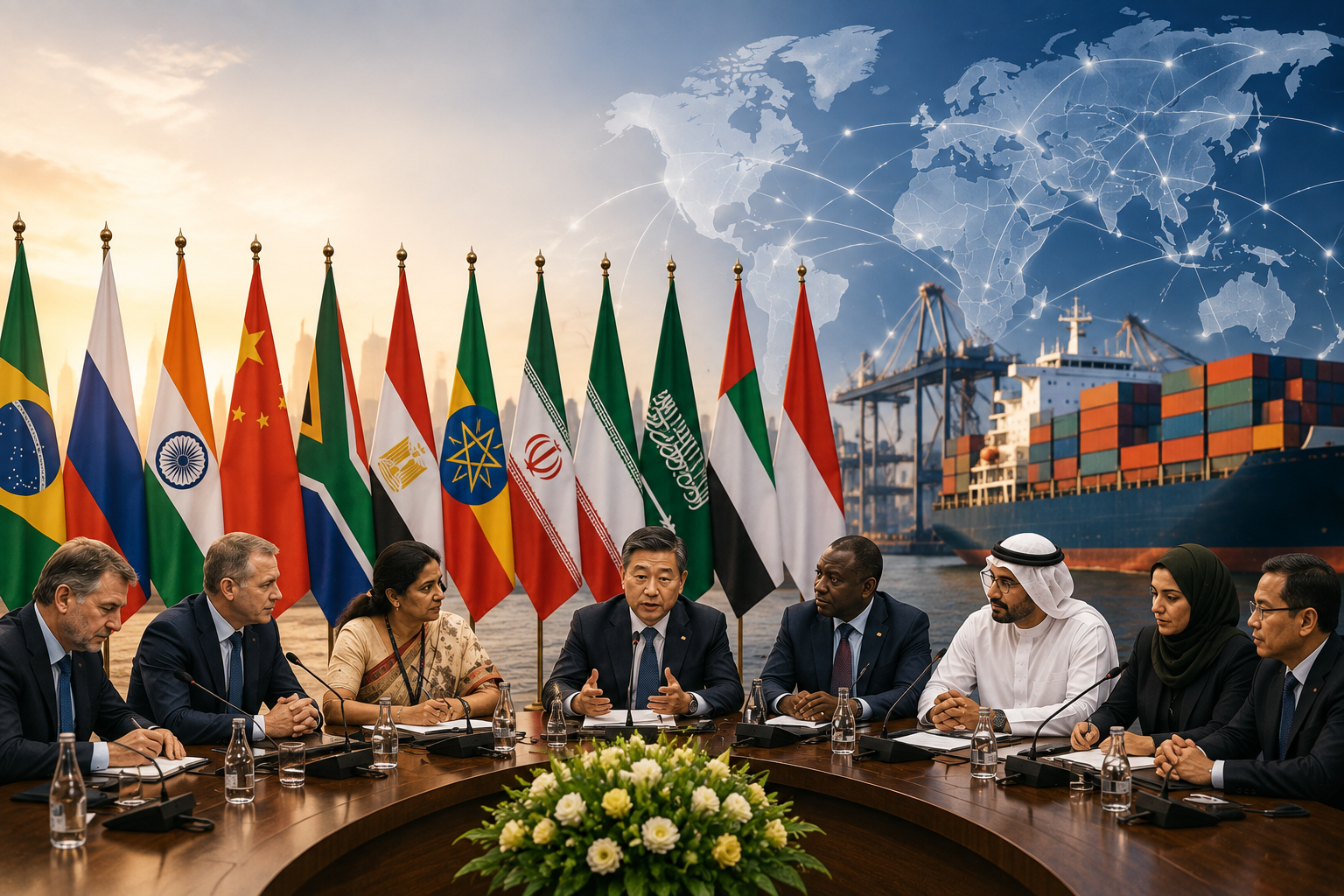
For a group whose members have increasingly portrayed themselves as a counterweight to the established economic order, BRICS has often struggled with the practical business of doing more business with one another.
This week, there was a modest but notable sign of progress.
At a meeting of BRICS trade ministers in Jaipur, Indonesia’s Trade Minister Budi Santoso said the group had reached agreement on most of the trade issues under discussion. The meeting produced a joint outcome document and four annexes covering areas from small-business finance to global supply chains and digital services. The agreements came as the world trading system faces growing protectionism, geopolitical tensions and the fragmentation of supply chains.
The achievement is less dramatic than the language sometimes used to describe BRICS. There was no new free-trade area, no common tariff regime and no sweeping overhaul of the global trading system.
Instead, the ministers agreed on a collection of practical measures designed to make trade among the increasingly diverse group of economies easier.
One of the most significant was the so-called Jaipur Consensus, under which BRICS will study a mechanism for invoice discounting to help smaller companies obtain financing against unpaid invoices. Ministers also adopted guidelines for assessing export-oriented micro, small and medium-sized enterprises on the basis of cash flow rather than traditional collateral.
That may sound technical. For smaller exporters, it is anything but.
The World Trade Organization estimates that the global trade-finance gap runs into trillions of dollars, with smaller companies among those most likely to be denied affordable financing. BRICS said its new measures are intended to help close that gap and give smaller businesses greater access to international markets.
The ministers also advanced a Global Value Chains Action Plan for 2026–2030, including proposals for a BRICS Technical Council, joint studies and the BRICS Connect initiative. The plan envisages cooperation on strategic supply chains and investment promotion, including in pharmaceuticals and food security.
Digital trade was another priority. BRICS members adopted principles intended to facilitate digitally delivered services across borders, reflecting an economy in which services increasingly move without the physical shipment of goods.
For Indonesia, which joined BRICS as a full member in 2025, the meeting offered an opportunity to press for a more open and predictable trading environment. Santoso called for stronger cooperation among BRICS countries as global trade patterns shift, while Indonesia has emphasised the importance of rules-based trade and a central role for the World Trade Organization.
That position illustrates one of the contradictions inside BRICS.
The grouping has frequently been described as an alternative to Western-led institutions. Yet many of its members are not seeking to replace the WTO. At Jaipur, ministers reaffirmed the WTO as the centre of the multilateral trading system, while calling for reforms that better reflect the interests of developing economies, including the preservation of special and differential treatment.
The more immediate question is whether the new agreements can make a measurable difference.
BRICS now includes economies with sharply different levels of development and different trade priorities. China is a manufacturing superpower; India is seeking greater access for its exports while protecting farmers; Brazil is a major agricultural producer; the Gulf members are seeking diversification beyond hydrocarbons; and countries such as South Africa, Egypt and Indonesia are looking for greater access to large emerging markets.
Finding language acceptable to all of them is one thing. Removing the barriers that make trade between them expensive and complicated is another.
The proposed Strategy for BRICS Economic Partnership 2030 may ultimately be the more important test. Ministers made progress towards finalising the strategy, which covers trade in goods and services, investment, the digital economy, innovation, financial cooperation and sustainable development. It will now go to BRICS leaders for endorsement.