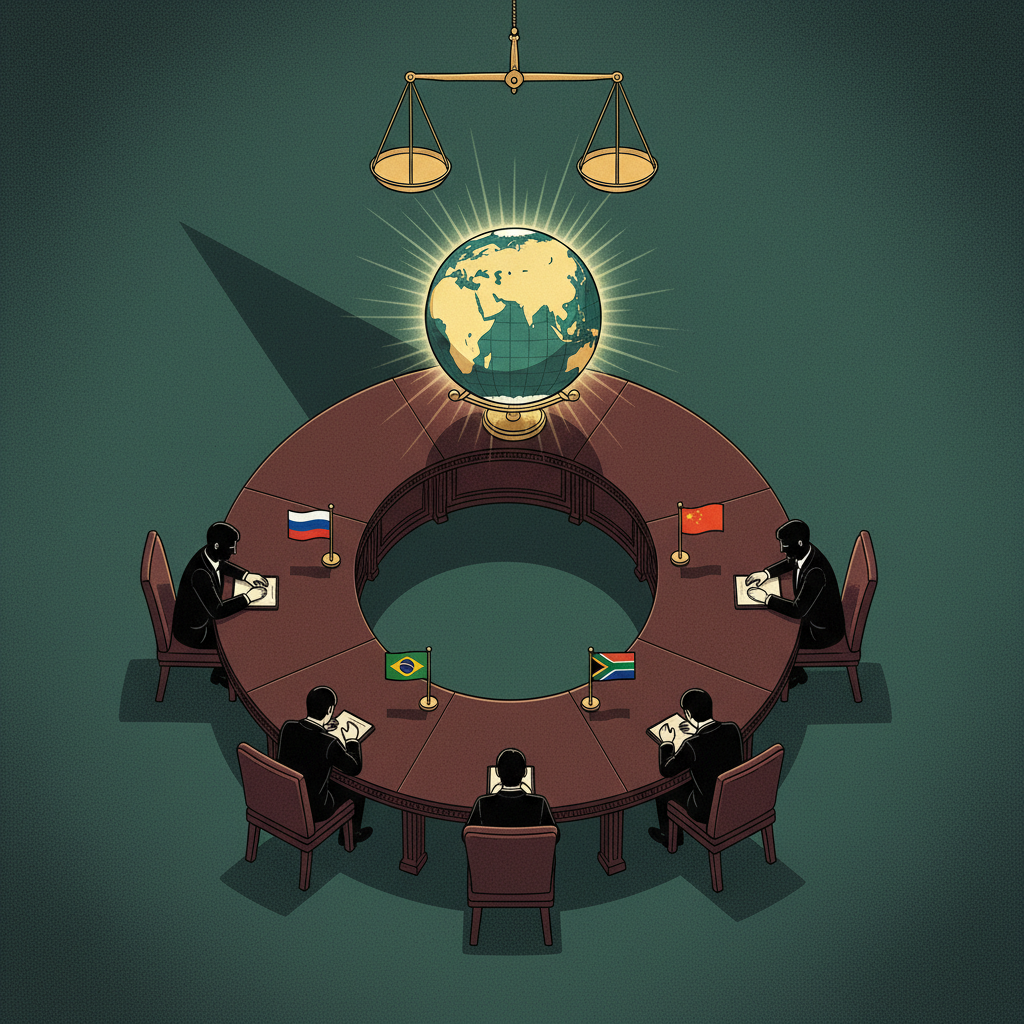
The BRICS Business Council will convene its Annual General Meeting (AGM) and flagship Business Forum in New Delhi this September, setting the private-sector agenda ahead of the 18th BRICS Summit scheduled for September 12–13, 2026.
Established in 2013, the BRICS Business Council comprises 50 senior executives serving as Chairs and Co-chairs from across the group’s member states. It acts as the principal bridge between the business community and BRICS governments, developing policy recommendations that are delivered to heads of state at each annual summit.
India, which holds the 2026 BRICS Chairship under the theme “Building for Resilience, Innovation, Cooperation and Sustainability, ” also chairs the Business Council for the year – its third turn after 2016 and 2021.
The Business Forum will take place on September 11 at the Bharat Mandapam convention centre, one day before heads of state gather for the Leaders’ Summit. The Business Forum and the AGM of the BRICS Business Council are widely viewed as a bellwether for the priorities that will emerge from the Leaders’ Summit, offering the clearest signal yet of where BRICS economic cooperation is heading as the grouping marks its second decade of formal summits.
With the expanded membership now spanning three continents, business leaders will be watching closely to see how the Council translates its ambitions into concrete commitments on trade, investment and sustainable development.
The SA Council recently launched a series of structured consultative dialogues to strengthen South Africa’s trade and investment ties with BRICS+ countries. Speaking at the consultative session, Council member Advocate Mtho Xulu said South African businesses are calling for a stronger, more practical BRICS agenda, one that opens new markets, reduces trade barriers, and makes it easier for companies to do business across one of the world’s fastest-growing economic groups.
As global trade patterns continue to shift amid geopolitical tensions, supply chain realignments, and slowing growth in traditional export markets, the South African chapter of the BRICS Business Council believes it is time to move beyond high-level discussions and focus on tangible commercial opportunities. Xulu also called for solidarity among African countries within the BRICS alliance.
The upcoming AGM will finalise the Council’s annual report, a key deliverable outlining trade, investment and cooperation priorities for the coming year. The Business Forum – the grouping’s flagship privatesector platform, convened annually in the summit host country – is expected to draw business leaders, ministers and senior officials for a series of high-level panels.
The agenda includes sessions on strengthening trade by reducing non-tariff barriers and building resilient supply chains across BRICS, alongside discussions on agribusiness, agri-tech innovation, digital farming and post-harvest management. The meetings come at a pivotal moment for the alliance, which has grown significantly since its founding.
BRICS now comprises ten full members – Brazil, Russia, India, China, South Africa, Egypt, Ethiopia, Iran, the United Arab Emirates and Indonesia – supported by a further ten partner countries. Together, member states account for roughly 41 percent of global GDP in purchasing-power-parity terms, giving the grouping substantial weight in world trade and investment flows.
Analysts expect the Council’s recommendations to focus heavily on supply-chain diversification, digital economy and artificial intelligence cooperation, and greater financial integration – themes that have dominated the agenda in recent years as it pushes for reforms to global economic governance and reduced reliance on Western-dominated financial systems.
Working groups set up under India’s chairship have already held a series of meetings throughout the year, covering trade and investment, infrastructure and logistics, digital economy and AI, energy and green finance, and skills development.