South Africans mean business.
That much was clear from a message that the Chairperson of the SA chapter of the BRICS Business Council, Busi Mabuza, shared with delegates ahead of the 18th BRICS Summit taking place in the Indian capital next month.
The Council will meet for their own two-day Business Forum and Annual General Meeting in New Delhi 10-11 September, shortly before the main event 12-13 September.
Mabuza urged business leaders to go there with “a singular, focused and measurable commercial objective: to address the persistent trade and skills-exchange deficit between India and South Africa.”
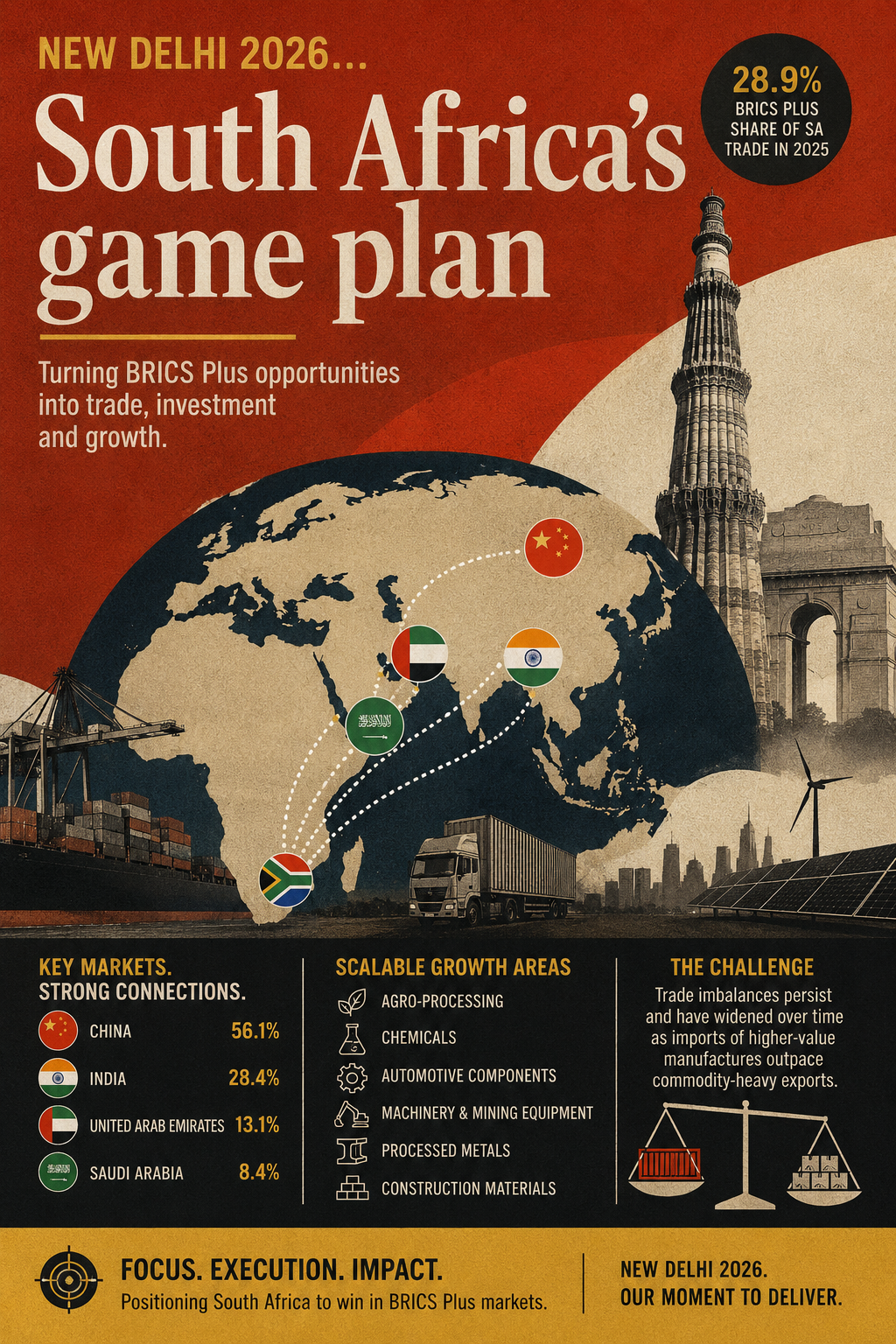
India is one of South Africa’s most significant BRICS+ trading partners, accounting for 28.4% of South Africa’s BRICS+ trade in 2025, yet South Africa recorded a deficit of approximately US$3.18 billion with India last year, with exports still dominated by coal, manganese and chemical wood pulp, while imports were concentrated in petroleum, vehicles, pharmaceuticals and machinery.
“This imbalance should not be treated as a stubborn constraint, but as a practical commercial opportunity to move South African firms into higher-value exports, Indian supply chains, joint ventures, technology partnerships and skills-transfer arrangements,” Mabuza said.
“The delegation’s priority in India must be to reposition the relationship from a buyer-seller model into a structured programme of co-investment, technology collaboration, market access and human-capital development. India’s economy represents a market of approximately 1.4 billion consumers, driven by rapid digitalisation, industrial expansion and a growing middle class.
“South African enterprises must therefore enter the meetings with clear sector-specific mandates: a defined value proposition, proposed partnership model, export or investment ask, standards and certification requirements, and the human-capital capabilities required to make each opportunity commercially executable.”
She outlined clear, sector-specific goals for the Council’s Asian mission:
Advanced manufacturing and automotive components: Leverage Indian technology, capital and component-supplier networks to position South Africa as a regional production hub for Africa and selected global markets, while negotiating localisation, supplier-development and after-sales capability commitments.
Pharmaceuticals and medical devices: Establish secure partnerships for active pharmaceutical ingredient supply, finished-dose manufacturing and medical-device assembly, using South Africa’s platform to access African markets under the African Continental Free Trade Area.
Information technology and digital services: Negotiate structured skills-exchange programmes that place Indian expertise within South African firms while training young South Africans in software development, data analytics, artificial intelligence, cybersecurity and digital public infrastructure through jointly branded academies.
Agro-processing and fast-moving consumer goods: Position South Africa’s high-quality agricultural output and processed food products in India’s large retail and consumer markets, while importing appropriate Indian processing, packaging and cold-chain technologies to lift domestic value addition.
Renewable energy and green hydrogen: Pursue joint research, development, manufacturing and project-finance ventures that support both countries’ energy transitions and create a new export category for South African industrial capability.
“Let us be unequivocal: addressing the India–South Africa trade and skills deficit is not merely a diplomatic priority; it is a commercial necessity,” Mabuza said. “India’s next phase of growth will require partners that can offer resource security, African market access, industrial collaboration and innovation opportunities. South Africa has these advantages. By recalibrating the relationship towards higher-value exports, investment partnerships and institutionalized knowledge transfer, we can generate employment at home, strengthen our industrial base and build more resilient supply chains for both nations.”
BRICS has emerged as an important destination for South African exports, but the country continues to face a significant trade-composition deficit. Analysts says the strongest and most scalable growth opportunities lie in agro-processing, chemicals, automotive components, machinery and mining equipment, processed metals, and selected construction materials. At the country level, these opportunities are supported by South Africa’s comparative advantages and underlying demand trends.
BRICS accounted for 28.9% of South Africa’s total trade in 2025. China represented 56.1% of this trade, followed by India at 28.4%, the United Arab Emirates at 13.1%, and Saudi Arabia at 8.4%. However, trade imbalances remain a concern and have widened over time, as imports of higher-value manufactured goods increasingly outpace South Africa’s predominantly commodity-based exports.
South Africa has a surplus with only two countries – the United Arab Emirates and Ethiopia.