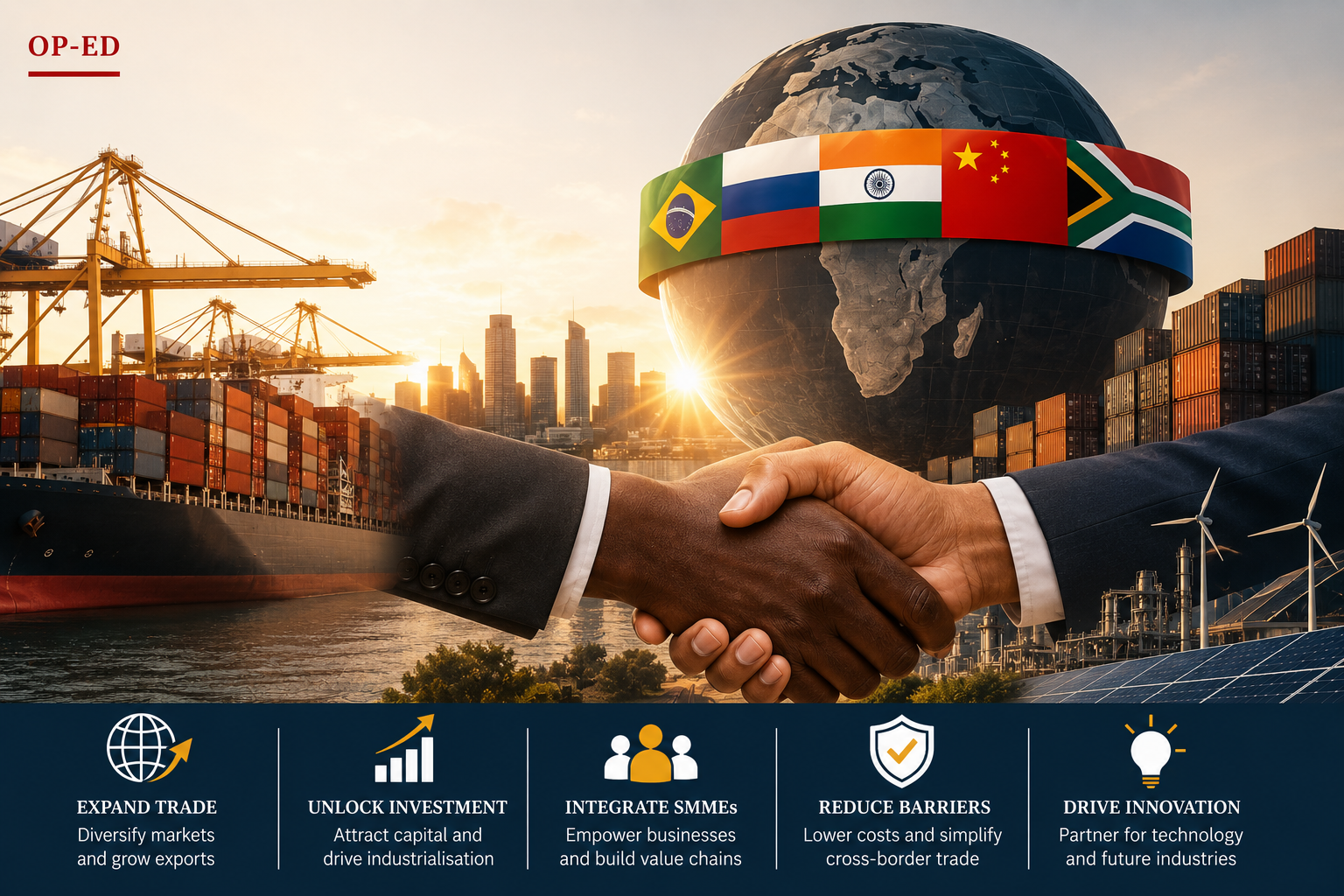
For much of its existence over the past 13 years, the South African BRICS Business Council has served as an important bridge between business and government, ensuring that the voice of the private sector is heard within the BRICS partnership. That role remains essential. But the demands of today’s global economy require something more ambitious. The Council is evolving from being primarily a business advocacy platform into a practical trade and investment accelerator focused on delivering measurable commercial outcomes for South African businesses. This evolution reflects the changing nature of BRICS itself.
BRICS can no longer be viewed simply as a diplomatic forum or a political dialogue among emerging economies. The expanded grouping has become one of the world’s most significant economic groupings, accounting for approximately 27% of global GDP, 24% of global merchandise exports and 22% of foreign direct investment inflows. Intra-BRICS trade has grown more than thirteen-fold over the past two decades, reaching an estimated US$1.17 trillion in 2024. For South Africa, these numbers represent a key opportunity.
In an increasingly fragmented global trading environment, BRICS offers South Africa an important platform to diversify export markets, attract strategic investment, strengthen industrialisation and build resilience against geopolitical and supply-chain disruptions. The challenge now is to convert these opportunities into tangible economic benefits.
That is where the SABBC’s evolving role becomes critical. The Council’s mission is becoming one of actively removing barriers that prevent companies from entering BRICS markets while creating practical opportunities for cross-border investment, business-to-business collaboration and market access.
This shift is particularly important because South Africa still exports predominantly primary commodities into BRICS markets. Although encouraging progress has been made in expanding exports of automotive products, chemicals, processed agricultural goods, industrial machinery, financial services and green economy technologies, approximately 85% of exports remain concentrated in raw materials.
South Africa’s long-term prosperity cannot depend on exporting commodities alone.
The country’s competitive advantage lies increasingly in adding value through manufacturing, beneficiation, advanced services and innovation. BRICS provides an ideal platform to support this transition by strengthening regional value chains and encouraging investment into higher-value sectors of the economy. Equally important is ensuring that these opportunities extend beyond large corporations.
Small, medium and micro enterprises must become central participants in South Africa’s BRICS strategy. Whether in pharmaceuticals, agro-processing, ICT, digital services, green technologies or mining services, SMMEs have the potential to become integral suppliers within regional and global value chains. Achieving this requires more than aspiration. It demands practical interventions, including business matchmaking, improved access to procurement opportunities, stronger supply-chain integration and expanded trade finance.
Reducing the cost and complexity of cross-border trade must also remain a priority. Exporters continue to face non-tariff barriers ranging from product certification requirements and sanitary regulations to customs delays and regulatory uncertainty. Smaller firms often bear these costs disproportionately. Greater interoperability between payment systems, more efficient customs processes and improved access to trade finance can significantly lower transaction costs and make South African businesses more competitive across BRICS markets.
Looking ahead, the next phase of BRICS cooperation will increasingly be defined by innovation and industrial transformation.
Artificial intelligence, digital services, fintech, green hydrogen, pharmaceuticals and critical minerals all present significant opportunities for South Africa. The country possesses abundant renewable energy resources, globally important reserves of platinum group metals, manganese, chromium and vanadium, and a growing technology ecosystem capable of supporting future industries. Success will depend on leveraging these strengths through technology partnerships, joint manufacturing, research collaboration and investment in advanced industrial capabilities.
India’s BRICS Presidency, under the theme Building for Resilience, Innovation, Cooperation and Sustainability, provides an important opportunity to accelerate this agenda. The alignment with South Africa’s own development priorities offers the potential to translate political goodwill into commercial implementation through expanded trade, investment and technology cooperation.
The next chapter of BRICS will not be defined by declarations alone. It will be defined by execution.
The South African BRICS Business Council is positioning itself accordingly—not simply as a forum for dialogue, but as a catalyst for investment, industrialisation and inclusive growth. By accelerating trade, unlocking investment, integrating SMMEs into regional value chains and reducing barriers to doing business, the Council is helping position South African companies to compete more effectively across one of the world’s fastest-growing economic partnerships.