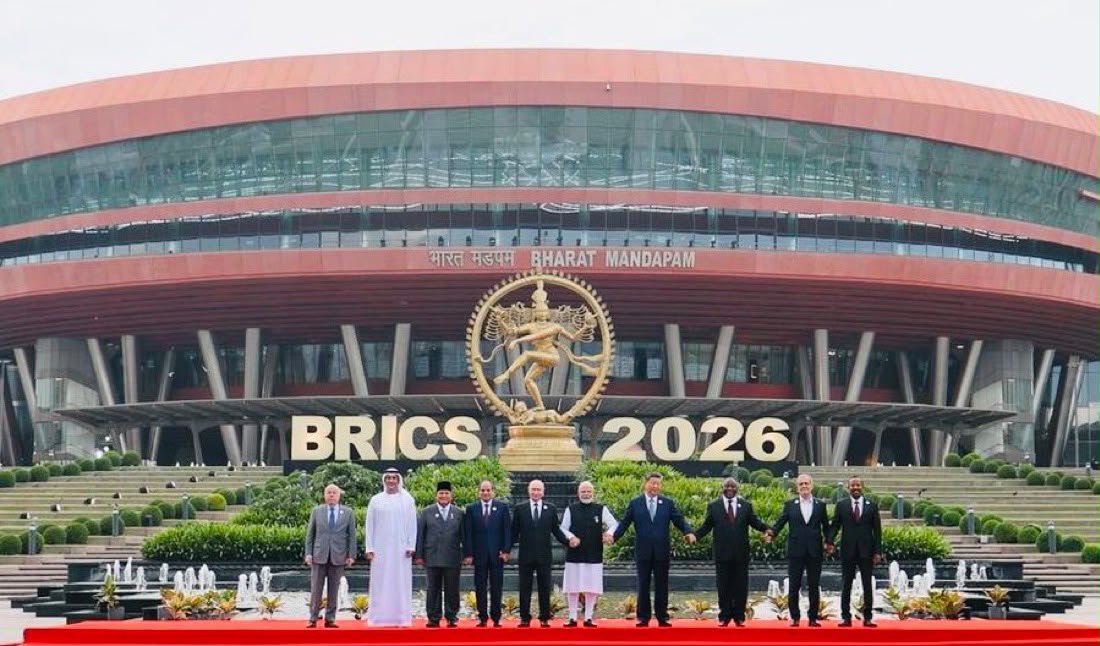
BRICS leaders have reached consensus on a joint statement at the 18th BRICS Summit in New Delhi, overcoming differences over some of the most divisive geopolitical issues facing the expanded grouping.
The New Delhi Declaration, adopted by leaders on September 12, sets out the alliance’s position on global governance, trade, finance, conflict, climate change, technology and development. Negotiations reportedly continued into the early hours of the morning as members worked to bridge differences, particularly over the conflict in West Asia.
On the Middle East, BRICS expressed deep concern over the escalation of violence and called for maximum restraint, dialogue and diplomacy. The agreement was particularly notable because the expanded grouping includes Iran as well as countries such as the UAE and Saudi Arabia, whose regional interests do not always align.
The declaration also takes a firm position against unilateral tariffs, sanctions and other trade restrictions, arguing that such measures can undermine developing economies and disrupt global supply chains. BRICS called for reform of institutions including the United Nations, IMF, World Bank and WTO to give developing countries greater representation.
Economically, the statement supports greater use of local currencies in cross-border trade and investment, alongside stronger interoperability between national payment systems. It does not establish a common BRICS currency, pointing instead towards incremental changes to the international financial system.
The declaration also expands the BRICS agenda into AI, space, critical minerals, energy and climate cooperation. On energy, members backed a just and inclusive transition while recognising that fossil fuels will continue to play an important role in developing economies.
Read the full statement here.